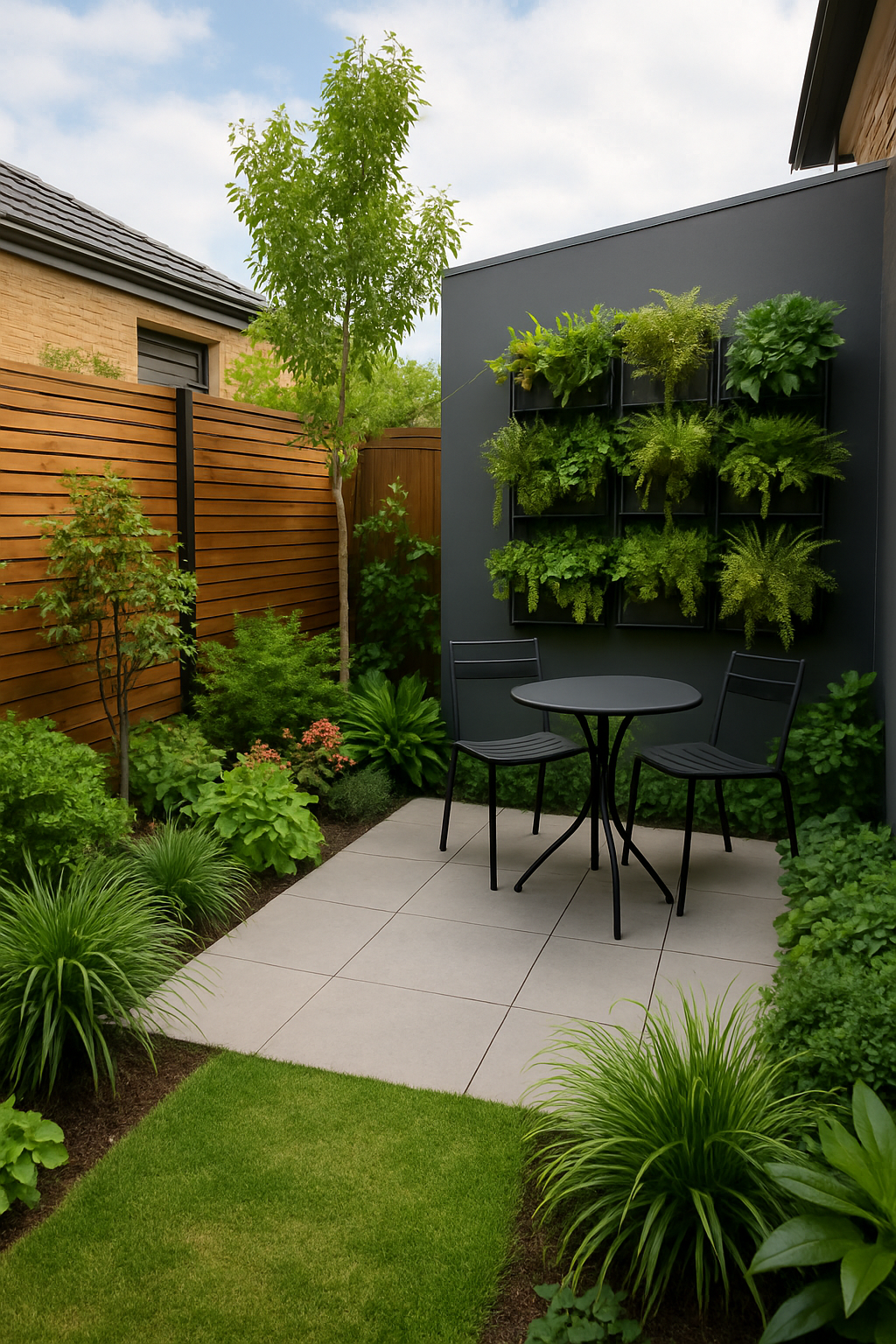
New Australian housing developments deliver smaller yards than ever before. Modern subdivisions in Brisbane fringe suburbs often have 100m² of usable backyard, sometimes less. The instinct is to feel cheated. The opposite is usually right: small yards, designed well, get used more than large yards designed badly.
The trick is treating a small yard as a design problem with constraints, not as a compromised version of a bigger yard. Here is how the best small-yard outcomes come together.
Pick a single primary purpose
The biggest mistake on small yards: trying to fit everything. The pool, the BBQ area, the kids’ play space, the herb garden, the dog run, the firepit, and the entertainment lawn — all crammed into 80m². The result is a yard that does none of those things well.
Pick one primary purpose. Build the yard around that. Everything else is a secondary feature that has to earn its space.
Examples that work:
- Primary: outdoor dining + entertaining → pergola, big table, BBQ. Secondary: vertical herb garden on one wall.
- Primary: kids play + family time → small grassed area, simple play equipment, shade. Secondary: small alfresco for parents to supervise.
- Primary: low-maintenance + visual interest → courtyard-style hardscape, planted perimeter, single feature tree. Secondary: small seating for morning coffee.
The small yard that does one thing brilliantly is loved. The small yard that tries to do five things is barely used.
Vertical space is your friend
Small yards force you to use vertical surfaces — and that often produces better results than spreading across horizontal space. Walls become useful real estate.
Vertical gardens. Modular planting systems mounted on a fence or wall give you a 3m × 2m garden in 6m² of fence. Looks great, easy to maintain, productive (herbs, salad greens) without taking floor space.
Climbing plants on pergolas or arbours. Wisteria, jasmine, and ornamental grapes turn 4m² of pergola into a leafy ceiling. Adds shade in summer, drops leaves in winter to let in sun.
Wall-mounted features. Outdoor mirrors visually double a small yard. A wall fountain or water feature provides ambient sound without floor space. Wall-mounted bench seating with planter boxes underneath uses zero floor space for storage and seating.
Multi-function elements earn their space
Anything that does two jobs is worth twice as much in a small yard. A built-in bench seat doubles as storage. A retaining wall doubles as informal seating. A pergola doubles as a clothesline support. The herb garden doubles as a privacy screen.
Think hard about everything you put in. If it does only one thing — moving the kids’ trampoline aside doesn’t really help when it occupies 30% of the yard footprint — it has to be working hard to justify the space.
Hardscape vs softscape — the right ratio
Generic landscaping advice tells you to balance hard surfaces with green. In a small yard, the right ratio is often more hardscape than people expect — because lawn doesn’t perform well at small scale.
A 30m² lawn is a high-maintenance feature that wears badly under regular foot traffic. The same 30m² as a paved or decked area is harder-wearing, easier to maintain, and visually anchors the space. Add planters, climbers, and feature trees to bring the green back, and the small yard reads as a courtyard rather than a tiny lawn.
Modern small-yard ratios that work: 60-70% hardscape (deck, paving, gravel) + 30-40% softscape (planted beds, climbers, single feature trees). Lawn under 20m² is rarely worth it — replace with paving + container planting and you get more usable space + lower maintenance.
The privacy question
Small yards in modern subdivisions usually have neighbours close enough to wave at. Privacy isn’t a nice-to-have — it determines whether you’ll actually use the yard.
The privacy options in order of effectiveness:
- Hedging — most natural look, takes 2-3 years to establish, cheapest long-term
- Bamboo (clumping, never running) — fast growth, soft visual, occasional maintenance
- Slatted timber screens — instant privacy, modern aesthetic, 8-15 year lifespan
- Lattice with climbers — privacy plus garden interest, takes a season to fill in
- Solid fencing extension — instant but visually heavy in a small space
Combine two approaches for the best result — a slatted screen along the most overlooked sightline plus hedging along the longer fences gives you instant privacy where it matters most plus a softer green wall everywhere else.
The lighting that transforms a small yard at night
Small yards become twice as useful when they work after dark. The lighting setup costs $200-$1,500 depending on scope and transforms a daytime-only yard into one used most evenings.
What works: low-voltage LED garden lights along path edges, uplights on feature trees or walls, festoon lights strung over the alfresco area. What doesn’t: overhead floodlights (clinical), single bare bulb fixtures (harsh), or anything bright enough to annoy neighbours.
Get the lighting right and the yard suddenly hosts dinner parties, evening conversations, and the slow Saturday evenings that make a house feel like a home. That’s the real ROI on a well-designed compact backyard.
Comments are closed