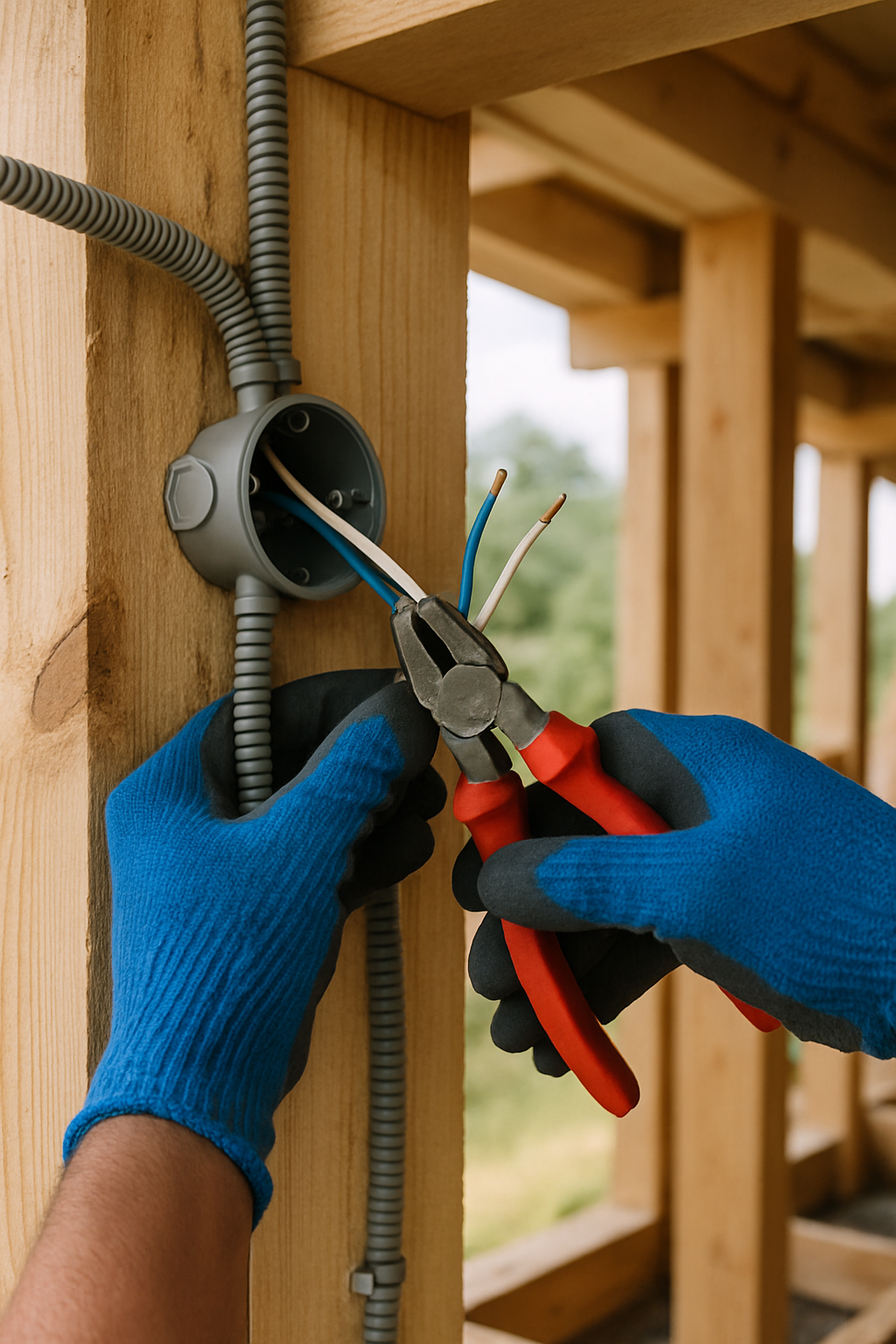
Owner-builders building granny flats consistently underestimate the electrical work. The mistake isn’t choosing the wrong appliance or buying the wrong fittings — it’s assuming the existing house meter and switchboard can handle a second dwelling. Sometimes they can. Often they can’t, and the discovery happens mid-build when adding the new circuits suddenly trips everything.
Here is what owner-builders need to plan for, what is legally restricted to licensed electricians, and where the budget surprises live.
Step one: assess the main supply
Most Australian homes built before 2000 have either 32-amp or 40-amp single-phase supply. That’s enough for a typical house with electric hot water, oven, cooktop, lights, and basic appliances — but at near capacity. Adding a granny flat with its own kitchen and hot water service often pushes total demand over what the supply can deliver.
The fix is one of:
- Upgrade to 63-amp single-phase ($800-$2,500 plus distributor fees)
- Upgrade to three-phase supply ($2,000-$8,000 plus distributor fees)
- Install a separate meter for the granny flat (required if tenanting separately)
- Reduce electrical load on the main house (replace electric hot water with gas, etc.)
An assessment by a licensed electrician early in planning saves you the painful discovery mid-build.
What’s legally restricted to licensed sparkies
Australian electrical regulations are strict. Owner-builders cannot legally:
- Connect new circuits to the switchboard
- Run cables in walls or ceilings beyond simple flexible cord extensions
- Install power outlets, light switches, or hardwired appliances
- Install switchboards or sub-boards
- Connect or modify the supply meter
- Install solar PV systems beyond plug-in micro-inverters
What you can legally do as an owner-builder: replace existing fixtures with like-for-like (e.g., swap a light fitting for the same type), and run extension cords. That’s roughly it. Anything more is licensed electrician work, and the fines for unlicensed work are substantial — plus your insurance won’t cover damage from non-compliant electrical.
The circuits a typical granny flat needs
A 1-bed granny flat with kitchen and bathroom typically requires:
- Lighting circuit (10A) — separate from power so you don’t lose lights when the kettle trips
- General power circuit (16A) — bedroom, lounge, smaller appliances
- Kitchen power circuit (16A or 20A) — fridge, microwave, kettle, toaster
- Cooktop circuit (20A or 32A depending on cooktop type)
- Hot water circuit (15A) — if electric hot water
- Air conditioning circuit (15A or 20A) — if split system
- Bathroom circuit (10A) — usually combined with main lighting
- RCD/RCBO protection on every circuit (mandatory under current regs)
That’s 6-8 circuits minimum. Each circuit requires breaker space at the switchboard, which means most granny flats need their own sub-board fed from the main board.
The smart-fitout decisions worth making
Owner-builders sometimes spec the bare minimum to keep cost down, then regret it within months. Worth the small upfront premium:
USB outlets in bedroom and lounge. Cost difference is $20 per outlet. Saves dealing with phone chargers permanently plugged into wall sockets.
Dimmable LED downlights with separate circuits per room. Bedroom dimmable to 10%, kitchen full-bright. Costs the same to install as fixed-output if specified upfront. Massively better quality of life.
Double outlets everywhere instead of singles. Costs $5-$10 more per outlet. Means you never have to choose between charging the laptop or running the lamp.
Outdoor outlet near granny flat door. $100-$200 retrofit later, $20 if specified at build.
Pre-cabling for future smart home, security camera, or NBN access point. Empty conduit installed during construction is almost free; retrofitting cable through finished walls is expensive and messy.
When to bring in a specialist electrician
Standard sparkies handle straightforward residential work fine. Where it gets specialist:
- Three-phase upgrades and main supply changes — needs distributor coordination
- Solar PV integration with the granny flat
- Smart-home automation (zigbee, KNX, smart switches)
- EV charging infrastructure
- Sub-metering for tenanted granny flats
For owner-builders in Brisbane and the Bayside areas wanting an electrician who handles granny flat fit-outs end-to-end (including the load assessment, sub-board installation, and the smart-home pre-cabling), Hack-It Electrical Solutions is worth talking to. They handle granny flat electrical as a specific service line rather than as an afterthought to standard residential.
Comments are closed